Overlapping Text in MacOS Tahoe
01-26-2026
I'm not the first person to ask questions about macOS Tahoe, but it has occurred to me that the reason Tahoe has these UI contrast / legibility oversights is that the operating system's physics is more expensive to apply usual contrast ratio approaches on.
Liquid Glass allows content to scroll and peek through from beneath these elements to give the interface a sense of dynamism and depth, all while maintaining legibility for controls and navigation.
source: Human Interface Guidelines
If it has this dynamism and depth, then this physics would exponentially increase the vectors to test for legibility. Here's an example I was reading about today. The Search field in the sidebar of the Settings.
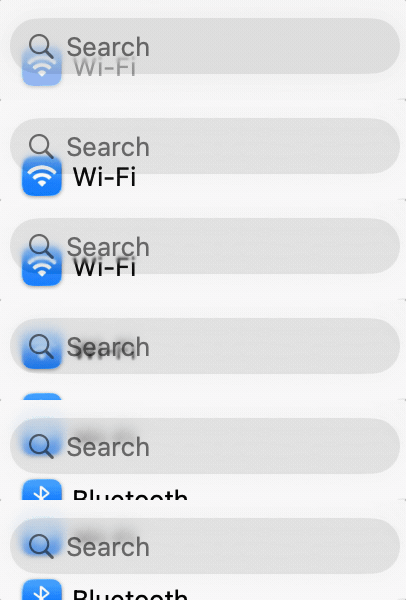
Liquid Glass would probably take some equally physically complex to test for the legibility. But without this, maybe it should just be blackbox testing plus feedback? I leaned on Claude Opus to see if it could detect the overlapping text. So I created an AI artifact that uploads a screenshot and detects overlapping text.
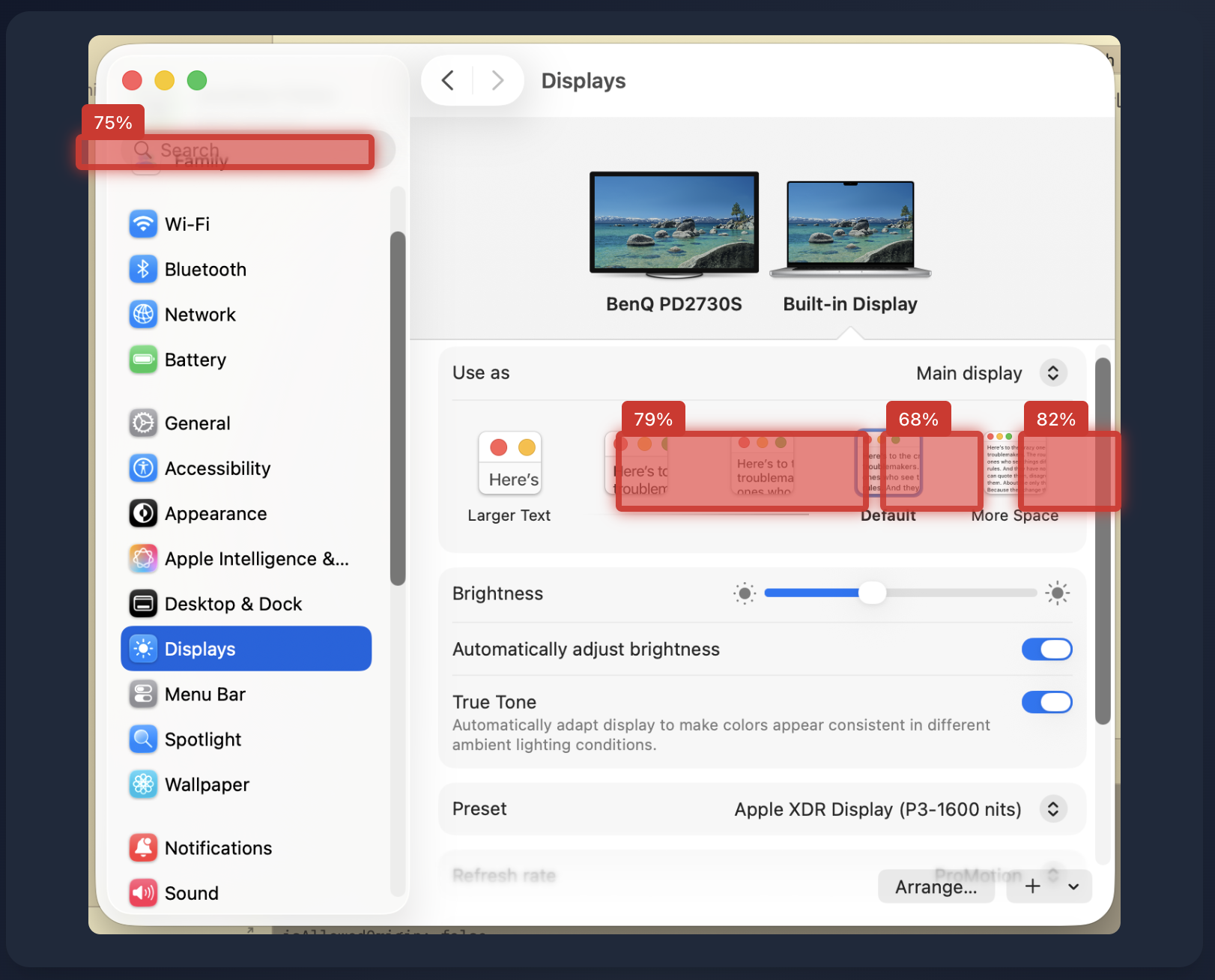
The result was also sensitive to text that is too small and potentially could have overlaps, but it did detect the overlapping text in the Search field as expected, despite the progressive blurring of the Search field.
For this detection to work, it would be weeks of fine-tuning to make it less expensive to run without LLM usage (a little expensive just to detect text-overlapping) and a ton of tuning toward what was acceptable optically for legibility. This is just the default use of liquid glass with no real consideration for realistic accessibility goals. But since there's transparency involved, there would need to be some "average" optical contrast ratio. With overlapping text like this, you'd think there'd be pixel-by-pixel changes in contrast ratio really requiring some comparison of what the blur provides for the contrast ratio, again emphasizing how contrast ratios just wouldn't work the same as a simple "this text on this solid background"? Maybe there are already standards on this?
So I'm convinced that if Liquid Glass is so central to Apple's current design language, that there were "object detection" similar to autonomous vehicle studies with 1000s of hours of macOS Tahoe usage footage. Where a team would just tune in and look for failures of legibility. So it's interesting that this one in Settings was overlooked? But my guess is that liquid glass being applied to macOS at its complexity presented such a large number of detected issues that if we realized how many problems they were able to resolve, it would be impressive.
Here's the artifact for reference.
← More writing